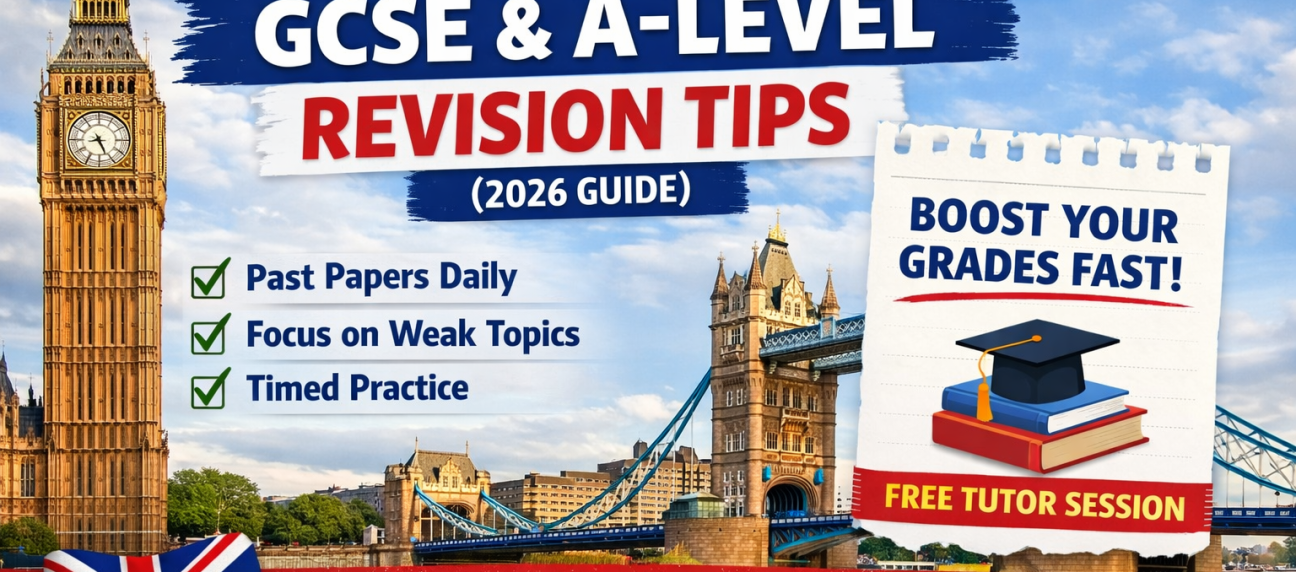
Exams Are Near – Here’s How to Turn Things Around Fast
If your GCSE or A-Level exams are just around the corner, it’s completely normal to feel stressed, overwhelmed, or even unprepared.
But here’s the truth most students don’t realise:
👉 You don’t need months to improve your grades — you just need the right strategy in the final days.
Every year, thousands of students dramatically improve their results in the last 2–3 weeks before exams. The secret isn’t working harder — it’s working smarter.
This guide will show you last-minute GCSE & A-Level revision tips that actually work in 2026, based on what top-performing students do differently.
1. Focus Only on High-Impact Topics
One of the biggest mistakes students make is trying to revise everything.
👉 That approach leads to:
- Burnout
- Confusion
- Wasted time
Instead, you should focus on high-impact topics.
✅ What are high-impact topics?
- Topics that appear frequently in past papers
- Core concepts (e.g. algebra in Maths, key theories in Science)
- Areas you personally struggle with
💡 Pro Tip:
Go through past papers from the last 5–10 years and identify patterns. You’ll notice that certain questions repeat in different forms.
👉 Focus on those first.
2. Do Past Papers Every Single Day
If you only follow ONE tip from this guide, make it this one.
👉 Past papers are the fastest way to improve your grades.
Why past papers work:
✔ You understand the exam format
✔ You learn how questions are asked
✔ You improve time management
✔ You identify weak areas instantly
📌 How to do it properly:
- Attempt at least 1 paper daily
- Do it under timed conditions
- Mark it immediately after
❌ Common mistake:
Students do papers but don’t review mistakes.
👉 Fixing mistakes is where real improvement happens.
3. Use the Power of Timed Revision (Pomodoro Technique)
Studying for hours without breaks doesn’t work — it actually reduces productivity.
Instead, use focused time blocks.
Recommended method:
- 50 minutes study
- 10 minutes break
Repeat 4 times, then take a longer break.
Why this works:
✔ Keeps your brain fresh
✔ Improves concentration
✔ Prevents burnout
👉 Short, focused sessions are far more effective than long, distracted ones.
4. Switch to Active Learning (Stop Passive Studying)
Reading notes or watching videos might feel productive — but it’s not enough.
👉 This is called passive learning, and it has low impact.
Instead, use active learning:
✔ Solve exam questions
✔ Write answers from memory
✔ Teach someone else
✔ Use flashcards
💡 Example:
Instead of reading a Maths formula:
👉 Solve 5–10 questions using that formula.
👉 That’s how your brain actually learns.
If you’re finding certain subjects more challenging than others, getting the right support can make a huge difference in your final grades. For example, students struggling with maths can benefit from expert help through our GCSE Maths Tutors UK, where qualified tutors break down complex topics into simple steps. Similarly, if you’re preparing for science exams, our A-Level Physics Tutors and A-Level Chemistry Tutors provide targeted support to help you master difficult concepts quickly. You can also explore our main Find a Tutor page to connect with expert tutors across all subjects and levels.
5. Focus on Weak Areas First (Not What You Like)
Most students revise topics they’re already good at.
👉 This feels comfortable, but it doesn’t improve grades.
What top students do:
✔ Identify weak topics
✔ Spend extra time fixing them
✔ Practice until confident
📌 Strategy:
- Make a list of your weakest topics
- Rank them from worst to best
- Focus on the top 3 first
👉 Fixing weaknesses gives the biggest improvement in marks.
6. Learn Exam Technique (This Changes Everything)
Many students lose marks not because they don’t know the answer — but because they don’t know how to answer properly.
Key exam techniques:
✔ Read questions carefully
✔ Look at command words (e.g. explain, describe, calculate)
✔ Structure your answers clearly
✔ Show working (especially in Maths)
💡 Example:
In Science:
👉 “Explain” requires more detail than “state”
Understanding this alone can improve your marks significantly.
7. Manage Stress & Stay Mentally Strong
Exams are not just about knowledge — they are also about mindset.
Common issues:
- Anxiety
- Overthinking
- Lack of confidence
What you should do:
✔ Get enough sleep (7–8 hours)
✔ Avoid comparing yourself to others
✔ Take short breaks
✔ Stay consistent
👉 A calm and focused mind performs much better in exams.
8. Create a Simple Last-Minute Study Plan
You don’t need a complicated timetable.
Simple daily plan:
Morning:
👉 Review weak topic
Afternoon:
👉 Do past paper
Evening:
👉 Review mistakes + quick revision
Weekly goal:
✔ Cover all weak areas
✔ Complete multiple past papers
✔ Improve time management
👉 Keep it simple and realistic.
9. Get Help When You’re Stuck
One of the biggest time-wasters is trying to figure everything out alone.
👉 If you’re stuck on a topic for hours, you’re losing valuable time.
Smart students do this:
✔ Ask teachers
✔ Use online resources
✔ Get help from tutors
👉 Sometimes, one explanation can save hours of confusion.
10. Use Expert Support to Boost Grades Fast
As exams get closer, targeted support becomes extremely powerful.
👉 Instead of struggling alone, getting help from experts can:
✔ Clarify difficult concepts quickly
✔ Improve exam technique
✔ Boost confidence
Final Advice: It’s Not Too Late
No matter where you are right now:
👉 You can still improve your grades.
The key is:
- Focus on what matters
- Practice consistently
- Fix mistakes quickly
Need Help Before Exams?
If you want to improve your grades faster and get expert guidance:
👉 Get a FREE session with GCSE & A-Level tutors
✔ Maths Tutors
✔ Physics Tutors
✔ Chemistry Tutors
✔ Biology Tutors
📥 Visit: tutorforu.uk
Don’t let last-minute stress affect your results — the right guidance can boost your confidence and performance significantly. Whether you need help with core maths skills, advanced science topics, or overall exam preparation, our platform makes it easy to connect with the best tutors. Explore our A-Level Maths Tutors UK, get expert support from A-Level Physics Tutors and A-Level Chemistry Tutors, or simply visit the Find a Tutor page to choose the perfect tutor for your needs and start improving your grades today.


Leave your comment