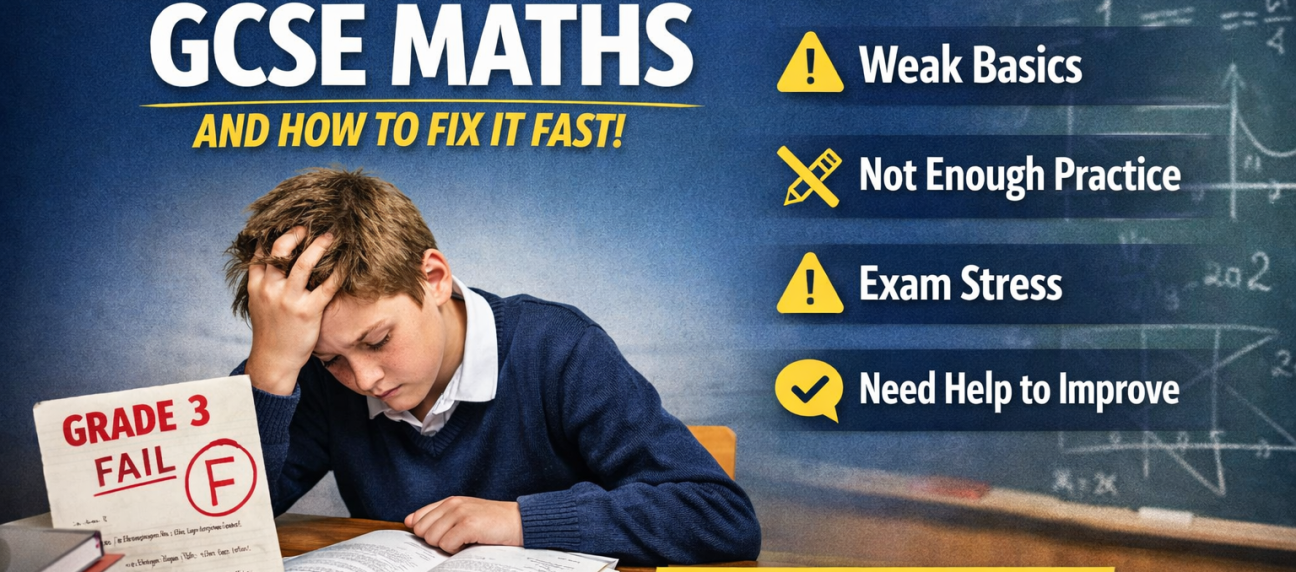
Why You’re Failing GCSE Maths (And How to Fix It Fast) – UK Student Guide 2026
Are You Struggling with GCSE Maths?
If you have ever searched:
“Why am I failing GCSE maths?”
“Why can’t I pass maths no matter how hard I try?”
You are not alone.
Thousands of students across the UK struggle with GCSE Maths every year. The truth is that failing is rarely about intelligence. It is usually about strategy, gaps in understanding, and lack of the right support.
The good news is that this can be fixed quickly with the right approach.
The Real Reasons Students Fail GCSE Maths
Weak Foundation
GCSE Maths builds on earlier knowledge such as fractions, percentages, and basic algebra. If these fundamentals are weak, advanced topics become difficult to understand.
For example, if fractions are not clear, algebra and equations will feel confusing. This creates a chain reaction that affects overall performance.
Passive Revision
Many students revise in ways that do not actually improve performance. Reading notes, watching videos, or highlighting textbooks may feel productive, but they do not build problem-solving skills.
Mathematics is a practice-based subject. Improvement only comes from solving questions consistently.
Exam Pressure and Anxiety
Some students understand topics but struggle during exams due to pressure. This leads to panic, mistakes, and poor time management.
Exam performance is not just about knowledge. It also depends on confidence and technique.
Poor Use of Past Papers
Past papers are one of the most powerful tools for GCSE success, yet many students use them incorrectly or avoid them altogether.
Common mistakes include not timing themselves, not reviewing answers properly, and ignoring repeated errors.
Gaps in Key Topics
Missing knowledge in core topics can significantly reduce your grade. Areas like algebra, ratio, trigonometry, and word problems often carry high marks in exams.
If even one of these areas is weak, it can affect overall performance.
Quick Self-Assessment
If you are struggling with GCSE Maths, the most likely reasons are:
Weak basic understanding
Lack of consistent practice
Poor exam technique
Unstructured revision
Fixing these areas will lead to improvement.
How to Fix GCSE Maths Fast
Identify Your Weak Topics
Start by taking a past paper and marking it honestly. Identify patterns in your mistakes.
For example, if you consistently lose marks in algebra or word problems, those should become your priority.
Focus on High-Value Topics
Certain topics appear more frequently in exams. Focus on areas such as algebra, ratios, percentages, graphs, and probability.
Mastering these can significantly improve your grade.
Practice Daily
Consistency is key. Aim to practice for at least 30 to 60 minutes every day.
Focus on solving questions rather than reading notes. This builds confidence, speed, and accuracy.
Use Past Papers Effectively
Complete one past paper every few days under timed conditions. After completing it, carefully review your mistakes and understand where you went wrong.
Repeat similar questions until you are confident.
Improve Exam Technique
Many students lose marks not because they lack knowledge, but because they do not apply it correctly.
Always show full working, read questions carefully, and attempt every question. Even partial answers can earn marks.
Seek Help When Needed
If you are stuck on a topic for too long, it is important to get help. Spending too much time confused can slow your progress.
A tutor can often explain difficult concepts quickly and clearly, saving you valuable time.
Do You Need a Tutor for GCSE Maths?
If you are currently stuck at a grade 3 to 5 level, not improving despite effort, or feeling confused about key topics, then additional guidance can make a significant difference.
A good tutor can identify your weaknesses, simplify complex concepts, provide targeted practice, and improve your exam technique.
Realistic Grade Improvement
With the right strategy and consistent effort, improvement is achievable.
A student at grade 3 can move to grade 5.
A student at grade 4 can reach grade 6.
A student at grade 5 can aim for grade 7 or higher.
The key is focused practice and proper guidance.
Tips from High-Performing Students
Practice daily, even if it is for a short time
Focus more on weak areas than strong ones
Use past papers regularly
Learn from mistakes instead of ignoring them
Stay consistent rather than studying in bursts
Common Mistakes to Avoid
Leaving revision too late
Relying only on videos or reading
Avoiding difficult topics
Not asking for help
Ignoring exam technique
Final Thoughts
GCSE Maths is not about natural talent. It is about practice, strategy, and consistency.
Many students improve their grades significantly within a short period once they adopt the right approach.
Need Help Before Exams?
If you want to improve your GCSE Maths quickly, expert support can make a real difference.
👉 Get help from TutorForU UK
They offer one-to-one sessions with experienced tutors, flexible online learning, and a strong focus on exam success.
Book a Free Session
Visit: https://tutorforu.uk
Frequently Asked Questions
Why am I failing GCSE maths even after revising?
Because revision alone is not enough. You need consistent practice, strong fundamentals, and effective exam technique.
Can I pass GCSE maths in one month?
Yes, it is possible if you focus on key topics, practice daily, and use past papers effectively.
What is the fastest way to improve GCSE maths?
Target weak areas, practice regularly, and seek help when needed.
Is GCSE maths difficult to pass?
With the right approach and support, most students can achieve a passing grade.
How many hours should I study GCSE maths daily?
Most students benefit from 30 to 60 minutes of focused practice daily. Consistency is more important than long study sessions.
What topics should I focus on to pass GCSE maths?
Focus on high-impact topics such as algebra, percentages, ratios, graphs, probability, and basic geometry, as these appear frequently in exams.
Why do I understand maths in class but fail in exams?
This usually happens due to lack of exam practice, poor time management, or anxiety during exams. Practicing past papers under timed conditions helps solve this.
Is it too late to improve my GCSE maths grade?
No, it is never too late. With focused revision and daily practice, many students improve significantly even in the last few weeks.
How can I improve GCSE maths without a tutor?
You can improve by using past papers, practicing daily, focusing on weak topics, and using reliable online resources. However, a tutor can speed up the process.
What is the easiest way to pass GCSE maths?
The simplest approach is to focus on core topics, practice regularly, and master exam techniques like showing working and managing time effectively.
How important are past papers for GCSE maths?
Past papers are essential. They help you understand exam patterns, improve speed, and identify weak areas that need attention.
Can I pass GCSE maths by only doing past papers?
Past papers are very helpful, but they should be combined with topic practice to fully understand concepts and avoid repeating mistakes.
What grade do I need to pass GCSE maths in the UK?
A grade 4 is considered a standard pass in GCSE Maths in the UK. Higher grades like 5 or 6 are often required for further education options.
How do I stay motivated while revising GCSE maths?
Set small daily goals, track your progress, reward yourself after study sessions, and focus on improvement rather than perfection.



Leave your comment